
.png)
AI Enablement for Businesses with Strategic IT

Introduction
The story is familiar. A business owner hears constant buzz about artificial intelligence, signs up for a few tools, maybe asks a chatbot to write an email or summarize a report, and then looks around the office and thinks nothing has really changed. The work feels the same, the bottlenecks are still there, and the team is not any closer to real AI enablement for businesses.
Most companies treat implementing AI in business like signing up for another software subscription. Someone buys access to a generative AI app, a marketing agency tests an AI copy tool, and leadership hopes it will somehow lead to smarter, faster operations. That approach skips the hard work underneath the surface, which is where the real value lives.
This is where AI adoption consulting and strong IT come together. Successful AI does not sit on top of the business like a shiny toy. It lives inside the infrastructure, tied into data, security, networks, and day‑to‑day workflows. That is why IT consultants, not marketing teams, are often the missing piece. In this article, the focus is on what is actually blocking AI progress, why IT consultants matter so much, and how SingleWave Technologies helps build the kind of foundation AI can trust.
Key Takeaways
Before diving deeper, here is a quick summary for readers who want the main points up front.
AI enablement is mostly an infrastructure and operations challenge rather than a marketing project. Buying a tool is easy, but real change needs strong networks, data systems, and security that support AI all day, every day. When those parts are weak, even the best AI app feels like a toy.
Most failed AI attempts trace back to IT gaps, not bad software. Weak data, old servers, scattered apps, and no clear plan leave AI tools starved of what they need to work. The result is slow adoption, low trust, and money spent with little to show for it.
IT consultants give structure to AI plans by connecting business goals with real technical work. They create a clear business AI strategy, check infrastructure readiness, and guide steps for safe, steady AI use. This cuts risk while keeping progress steady and practical.
SingleWave Technologies focuses on AI enablement as an infrastructure project for St. Louis area organizations. With managed IT, cloud services, cybersecurity, and strategy work, SingleWave helps businesses turn AI from a buzzword into a reliable part of daily operations.
Companies that prepare their infrastructure ahead of time gain a real edge. They roll out AI projects faster, keep systems stable and secure, and free their teams to focus on work that moves the business forward instead of fighting with tech.
Why AI Enablement Is An Infrastructure Problem, Not A Marketing Campaign

Most AI talk centers on visible tools. Chatbots on websites, AI features in email platforms, or a smart assistant that drafts social posts often get the spotlight. Those pieces matter, but they sit at the surface. When leaders view AI as a marketing campaign instead of an infrastructure project, they stop at that surface layer and skip the deeper work needed to support AI day after day.
Under the hood, AI has a long list of needs:
Data that is accurate, current, and reachable across the business
Cloud platforms that can handle heavy workloads without slowing down other tools
Clean connections between core systems so information can move smoothly from one app to another
Without this kind of base, even well‑designed AI implementation services and AI integration services fall flat.
“Data is the new oil. It's valuable, but if unrefined it cannot really be used.”
— Clive Humby, data scientist
Research often sums this up with a simple 10–20–70 idea, a framework supported by findings on the State of AI in the enterprise. Only a small slice of AI success comes from the algorithms themselves. A bit more comes from the right technology and data stack. The largest part comes from people and processes, which includes how IT systems are set up and managed. In practice, that means the difference between success and failure often lives in everyday infrastructure choices, not in which AI brand someone picks.
Many mid‑sized companies discover this the hard way:
They add a chatbot to the website but find it cannot access customer history.
They test an AI assistant for contracts, but the file server is a mess of outdated and repeated documents.
They ask a marketing agency to do more with AI, but the agency has no control over internal systems.
At that point the real question becomes clear: when it comes to AI consulting vs marketing agency roles, which partner is able to work on the foundation?
What Marketing Agencies Handle | What IT Consultants Handle |
|---|---|
Content and campaigns that may use AI tools | Design of AI‑ready infrastructure across the business |
Brand voice, visuals, and messaging guidelines | Secure data environments AI tools can safely access |
Channel strategy and marketing automation | Integration between line‑of‑business apps and AI tools |
Tool suggestions for content and ads | Cloud design and managed services that keep AI stable |
The Real Barriers Stopping Businesses From Implementing AI Successfully

When AI experiments stall, many leaders assume the tools were not good enough or that AI is only for very large enterprises. In reality, the main blockers show up in the same few areas again and again, especially for mid‑sized businesses and nonprofits that grew fast without a long‑term IT plan.
Poor data and siloed systems are one of the biggest problems. Customer records might live in one system, billing data in another, and operations data in a third tool that does not talk to the others. AI cannot give reliable answers when it only sees part of the picture, so outputs feel random or off base. Staff end up copying data by hand, which adds even more room for errors.
Outdated infrastructure often cannot handle modern AI workloads. On‑premises servers that were fine a few years ago may struggle once staff start to use AI heavily. That leads to slow apps, timeouts, or sudden failures right when teams are trying new projects and need confidence in the system.
No clear AI game plan makes it hard to see real returns. Many companies run scattered pilots with no written roadmap, no defined business outcomes, and no agreed way to measure success. Without that structure, leaders do not know whether to expand, pause, or stop, so AI stays in an experimental stage.
Limited in‑house expertise is common for small and mid‑sized firms. A general IT person can set up email and handle everyday tickets, but large‑scale AI enablement for businesses needs experience in data architecture, cloud design, and security. When those skills are missing, teams fall back to small, low‑impact uses of AI.
Cybersecurity and compliance gaps make AI feel risky, especially in healthcare, legal, and nonprofit work with sensitive records. Every new AI tool touches more data, which widens the attack surface. Without a strong security plan that covers AI use, leaders worry about leaks, fines, or damage to reputation.
Change resistance from staff can slow even well‑planned projects. If employees think AI will replace their jobs or add more steps to their day, they drag their feet or skip the tools. Without training, clear messages, and visible wins, it is hard to build trust in new AI‑powered workflows.
Each of these barriers traces back to infrastructure and strategy more than to AI tools themselves. That is exactly the zone where a strong IT consulting partner can help.
Why IT Consultants Are The Missing Piece In Your Business AI Strategy
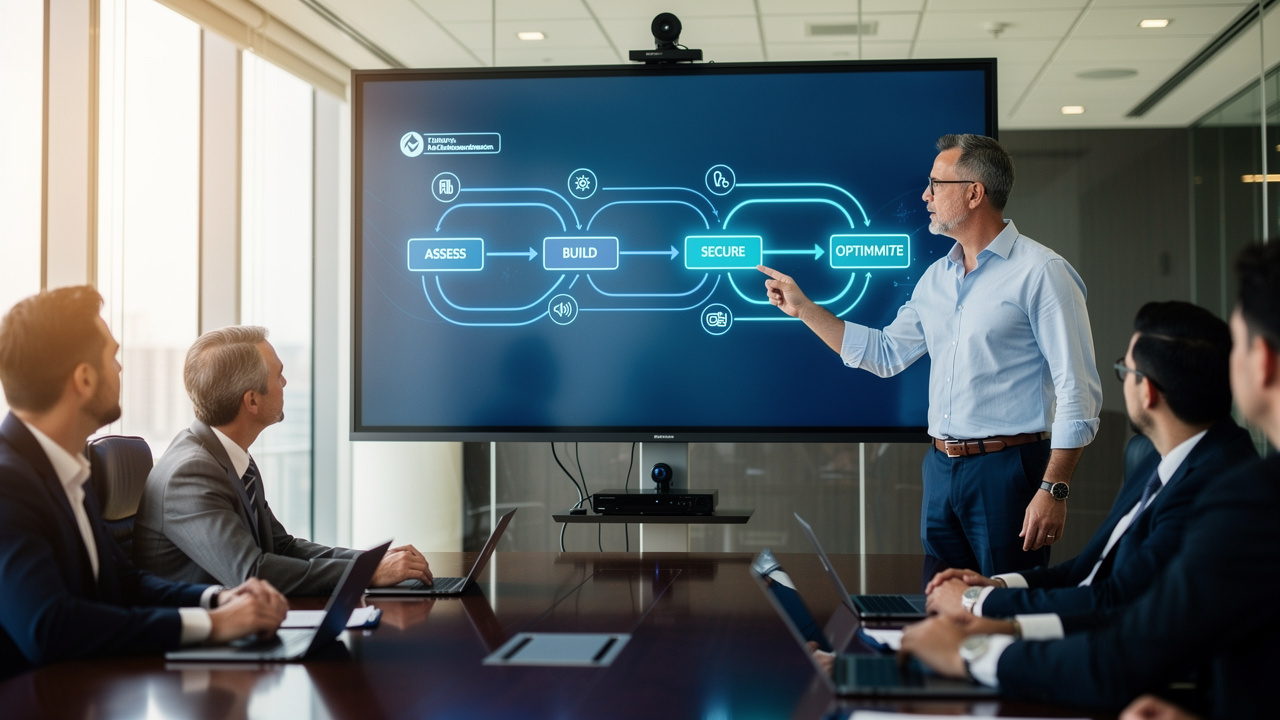
Marketing agencies and software vendors play useful roles, but neither group owns the core systems your business runs on. That is the space IT consultants live in. When leaders want AI to serve real business goals instead of sitting on the sidelines, IT consultants help connect high‑level plans with the technical work that has to happen behind the scenes.
Good IT partners start with strategic roadmaps instead of quick fixes, and data on AI adoption vs embodiment shows that only 1 in 50 AI initiatives deliver true transformation without this structured approach. They sit down with leadership to learn where the business wants to go and what is getting in the way. From there, they map out clear phases for AI adoption so the team moves in a steady, safe way rather than jumping from one tool to another. This turns scattered ideas into a practical business AI strategy that fits budget and risk tolerance.
A helpful way to see the value of IT consultants is to look at the stages they guide during AI adoption.
Assess
The process starts with a careful review of current systems, data, and security. The consultant checks whether your cloud setup, servers, and network can handle AI workloads without hurting day‑to‑day work. They also review data quality and access so they can flag gaps early.Plan
Next comes a written plan that links business goals with concrete steps. This includes picking a short list of use cases, setting target outcomes, and choosing the right mix of AI implementation services. The plan lays out timing, budget, and who owns each part, so there is no confusion once work starts.Build
During this phase, the IT partner designs and builds the technical pieces AI will rely on. That may cover cloud changes, data pipelines, and links between core apps and new AI tools. Instead of one‑off fixes, they design a structure that can support more advanced AI in the future.Secure
As AI touches more business data, security and compliance controls become more important. IT consultants set clear access rules, update security tools, and align the setup with any industry standards that apply. This keeps AI projects from creating new weak spots in your environment.Optimize
After launch, the work continues. The consultant tracks performance, looks for new risks, and suggests improvements over time. Because they already manage your broader IT environment, they can adjust AI‑related systems without throwing off other tools your team depends on.
For organizations in the St. Louis region, having this kind of partner close by matters. A local, plain‑spoken IT firm that understands mid‑sized companies, nonprofits, and professional services can translate AI goals into everyday steps without buzzwords or scare tactics.
How SingleWave Technologies Sets Up The Infrastructure AI Actually Needs

SingleWave Technologies views AI through an infrastructure lens first. Instead of pushing a single tool, the team focuses on making sure the entire environment is ready for steady, safe AI use. That approach fits the needs of small and mid‑sized businesses and nonprofits that cannot afford long downtime or risky experiments.
Through managed IT services, SingleWave keeps everyday systems healthy so AI projects do not sit on top of shaky ground. The team monitors devices, networks, and servers, handles updates, and responds to issues before they grow into outages. For a business adding AI‑powered tools, this means less worry that a simple infrastructure problem will bring new projects to a halt.
Cloud work is another key part of the picture. Many AI integration services rely on cloud platforms that can scale up when workloads spike. SingleWave helps plan and carry out cloud moves, or improve current cloud setups, so AI tools have the power they need without wasting money on unused capacity. This is especially helpful for growing St. Louis firms that want to keep flexibility as they add more AI use cases.
Security sits at the center of every AI discussion SingleWave has with clients. As AI reaches into email, files, customer databases, and line‑of‑business apps, the risk around data loss and misuse grows. SingleWave draws on its cybersecurity practice for small and mid‑sized firms to set clear controls, train staff, and apply protection that matches the real‑world threats companies face.
On top of this technical work, SingleWave offers IT strategy and business consulting that weaves AI into the broader technology plan. Rather than treat AI as an add‑on, they help leaders decide where AI can support long‑term goals and how to phase work in a way that fits limited budgets. For organizations still on older systems, SingleWave guides IT modernization projects so that outdated hardware and software no longer block AI adoption.
SingleWave Service | AI Infrastructure Challenge It Solves |
|---|---|
Managed IT Services | Prevents downtime and system failures that interrupt AI use across the business |
Cloud Solutions And Migration | Gives AI workloads flexible computing power without overloading local hardware |
Cybersecurity For Small And Mid‑Sized Firms | Protects the sensitive data that AI tools read and create |
IT Strategy And Business Consulting | Connects AI plans to real business goals and clear roadmaps |
IT Modernization | Removes legacy system limits that keep AI from reaching core operations |
For St. Louis area companies that want AI enablement for businesses without guesswork, SingleWave acts as a steady IT co‑pilot that keeps technology out of the way so teams can focus on their actual work.
Conclusion

AI is not just another line item in the marketing budget. It is a new layer in the technology backbone of a business, and that means success depends on infrastructure, data, and security far more than on any single app. When companies skip that foundation, AI tests feel messy, staff lose trust, and leaders decide AI is not worth the effort.
“AI is the new electricity.”
— Andrew Ng, computer scientist
The problem is rarely that AI is too advanced for mid‑sized organizations. The problem is that most teams have not had a partner who understands both the business side and the deep technical side at the same time. SingleWave Technologies fills that gap by acting as a dedicated IT partner rather than a distant vendor, building and managing the systems that modern AI needs to thrive.
If the next step is to see whether your own environment is ready for AI, consider a simple conversation with SingleWave. An infrastructure readiness review can highlight quick wins, hidden risks, and a clear path forward so AI becomes a practical tool for your staff instead of just more noise.
FAQs
What Is AI Enablement And How Is It Different From Just Using AI Tools?
AI enablement means putting the right infrastructure, data, security, and processes in place so AI tools work reliably inside your business. It covers cloud setup, system integration, and clear use cases tied to real goals. Simply signing up for an AI app skips this base, which is why many experiments never move past small tests.
Why Can’t A Marketing Agency Handle AI Implementation For My Business?
Marketing agencies focus on content, campaigns, and customer‑facing messaging that may use AI. Those are valuable skills, but they do not address servers, networks, security, and data pipelines. AI implementation depends on those deeper layers, which sit squarely in the world of IT consultants, so the best results come when agencies and IT partners each play their own part.
How Do I Know If My Business Is Ready For AI?
Readiness depends on several signs. You may need to step back and review your environment if:
Your data is scattered across tools or often out of date
Your servers or cloud systems feel stressed during busy periods
Staff rely on manual workarounds to move data between systems
You do not have a clear IT roadmap for the next 12–24 months
A structured IT assessment from a partner like SingleWave Technologies can show where you stand now and what changes would make AI safer and more effective.
What Does An IT Consultant Actually Do During AI Implementation?
An IT consultant starts by reviewing your current environment and business goals. They design the technical architecture, help adjust or move systems to the cloud, connect AI tools to your data, and put strong security controls in place. After rollout, they continue to monitor performance and fine‑tune the environment so AI stays reliable as your usage grows.

.png)
.png)
.png)
Related Articles

.avif)
.avif)
Ready to Eliminate IT Friction?
Let’s transform your technology into a competitive advantage. Schedule a strategy call today and experience seamless, secure, and scalable IT solutions tailored to your business needs.